The Rain Barrel Is Not the Whole Water Plan
A rain barrel garden watering plan helps you judge storage, demand and dry spells, so collected rain supports plants without leaving gaps in care.
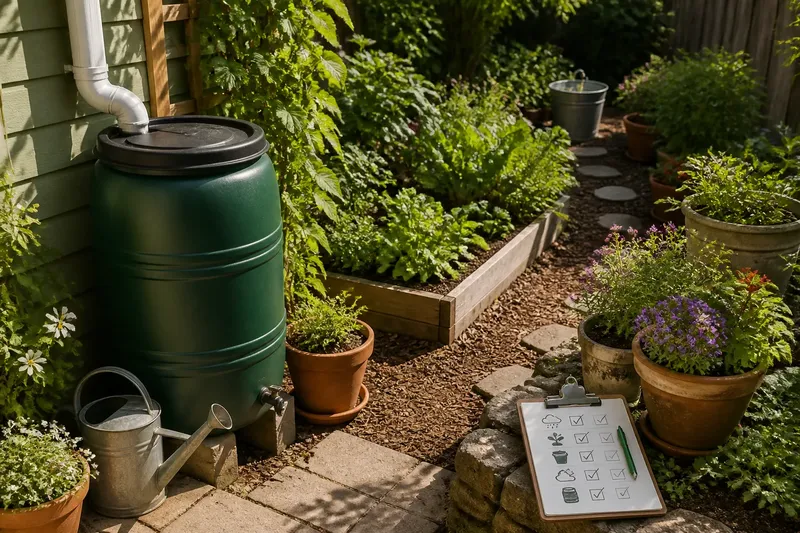
A rain barrel garden watering plan needs to account for what happens after the barrel fills and after it empties. A roof can send useful water to a storage tank, but the garden’s demand continues through dry weather, and the two do not neatly take turns.
The useful question is not whether a barrel is worth having. It is what role it can sensibly play alongside soil, plant choice, water access and the weather a particular garden actually gets. Treat it as one container in a larger system, rather than as a small reservoir with an unusually persuasive name.
Start with where rain can be collected
A barrel only collects water that reaches it. A downpipe connected to a suitable roof can supply a steady flow during rain, while a small shed roof or a roof divided among several outlets may provide less. Leaves, grit and roofing materials also affect what enters the tank and whether that water is appropriate for the intended use.
Look at the route from roof to barrel before choosing the barrel. Gutters should direct water towards the chosen downpipe rather than spill it behind a shed; a simple leaf screen can keep larger debris out. An overflow outlet matters too. Once a barrel is full, water still needs somewhere sensible to go, rather than pooling beside a wall or washing soil out of a bed.
Collected roof water is commonly used for ornamental plants and other suitable garden tasks. Do not assume that every roof surface or stored-water setup is suitable for every use, particularly on edible crops. Follow relevant product instructions and local guidance where these determine safe use.
Match storage to the garden’s demand
A large tank is not automatically a better plan. It takes space, needs a stable position and has to be accessible when full. A modest barrel can be more useful if it sits near the beds that need watering; a larger storage arrangement may make sense where collection area, space and regular use all support it.
Think about where water will be carried or delivered. A tap close to a bed makes a barrel easier to use than one behind a stack of pots. If water must travel in a watering can, consider the path, steps and weight when full. A garden may have ample stored water and still be awkward to water if the container is placed for convenience during installation rather than for use.
Storage is a buffer, not a measure of future rain. It can hold water from a wet spell for a later dry day, but it cannot keep supplying the garden indefinitely if rain does not return. A kitchen cupboard offers a useful analogy: having a shelf helps, but the shelf does not decide what you need to cook next week.
Let soil and planting shape the watering job
Water demand varies across a garden. A newly planted shrub, a shallow-rooted annual and an established plant in open ground do not necessarily need attention at the same time. Containers can dry faster than beds because their limited volume of compost is exposed on more sides; a sheltered border and an exposed pot may behave quite differently even when they share the same rain.
Soil changes the timing as well. Sandy soil tends to let water move through more readily, while heavier clay can hold water but may take it in slowly when dry. Organic matter can improve the condition of many soils, but it does not turn every bed into the same reservoir. Check the soil around the roots rather than watering by habit or by the appearance of a dry surface.
Where water is limited, make each application count. Water the root zone rather than wetting a broad area of bare ground, and give the water time to soak in. If it runs away over the surface, pause and allow it to enter before continuing. A slow, focused application is often more useful than a quick pass over leaves and paths.
Planting decisions can reduce pressure on stored water without making the garden dependent on one supposedly drought-proof species. Group plants with similar watering needs where practical, and reserve the easiest access to stored water for plants that are establishing or particularly sensitive to drying. Established plants suited to the site may need less frequent attention than newly planted ones, though weather and soil still matter.
Plan for dry spells before the barrel runs low
Dry spells are easier to manage when the gardener decides in advance what deserves priority. That does not require a rigid schedule. It means knowing which plants are newly planted, which containers dry quickly, and which parts of the garden can tolerate a pause in watering.
Imagine a gardener with one barrel beside a vegetable bed and a row of pots by the back door. During a dry stretch, they check the soil near the roots, give newly planted vegetables and the thirstier pots focused water, and leave established plants that still have moisture in the ground alone. The observable result would be water directed towards plants with a more immediate need, while the remaining stored supply is not spent on already damp soil.
Make the alternative source part of the plan, not an afterthought. That might mean access to a mains tap, a water butt fed from another suitable downpipe, or a decision to reduce the area of plants needing frequent attention. The right option depends on the home, local restrictions and the plants involved. A rain barrel can reduce reliance on another source when rain has been collected, but it cannot replace access planning for a prolonged dry spell.
Use a simple routine to judge what is needed
A short check, repeated when conditions change, is more useful than watering on the same day each week regardless of weather. Look at rainfall, the dampness beneath the surface, the condition of containers and the level in the barrel. Keep the check practical: it is meant to guide a decision, not become another garden ceremony.
- Check the barrel level. If it is low, direct its remaining water to the plants that need it most and consider the next available source.
- Check below the surface. If soil near the roots is still damp, wait rather than watering because the top looks pale or dusty.
- Check containers individually. Their compost and exposure differ, so do not assume a row of pots dries at the same rate.
- Check the weather outlook. If useful rain is expected, avoid watering already moist ground simply to keep a routine.
- Check the overflow route. If water is spilling where it could cause nuisance or erosion, adjust the arrangement in line with the equipment instructions.
- Check access before a dry spell. Make sure the tap, watering can and any alternative supply are usable without moving obstacles or carrying water an unreasonable distance.
These checks are not a claim that every garden needs the same routine. They help make the decision visible: water now, wait, or save the supply for a more vulnerable plant. If a plant is wilting, inspect the root-zone moisture before assuming the barrel is the answer; wilting can have causes other than dry soil.
Questions gardeners ask about rain barrels?
Can rain-barrel water be used on vegetables?
That depends on the roof surface, collection equipment, storage conditions and the way the water will be applied. Check local guidance and the instructions for the system, and avoid assuming that water suitable for ornamental beds is automatically suitable for crops eaten raw.
Should I water plants whenever the barrel is full?
No. The barrel’s level says how much water is stored, not whether the soil needs it. Check moisture near the roots and water only where conditions and the plant’s needs call for it.
What should I do when the barrel is empty?
Prioritise newly planted or vulnerable plants, check which containers are drying, and use a suitable alternative source if one is available. If water is restricted, reduce avoidable demand rather than spreading a small supply thinly over every plant.
Is one barrel enough for a garden?
There is no universal answer: collection area, storage space, plant mix, soil and dry-weather patterns all affect usefulness. A small barrel may serve a few nearby beds well, while a larger or additional collection arrangement may suit a garden with greater demand and enough room.
Keep the plan flexible
Review the arrangement after the garden has used it through wet and dry conditions. Notice whether water is easy to reach, whether overflow causes a problem, and which plants repeatedly need attention. Those observations can point to a better barrel position, a different watering priority or a more suitable mix of plants.
A rain barrel garden watering plan works best when storage has a clear job and limits are acknowledged. Collect rain where the setup allows, use it where it helps, and keep a sensible response ready for the weeks when the sky contributes nothing. The barrel is useful; it simply cannot be asked to manage the whole garden.