Reading a Patch of Light Before You Plan a Border
Reading a patch of light before planning a border helps you place plants where their leaves, flowers and growth habits suit the sun they actually receive.
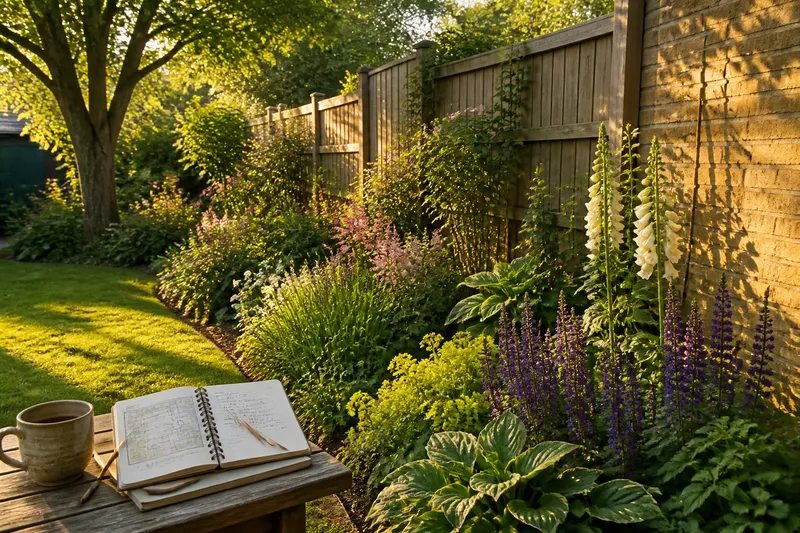
Reading a patch of light before you plan a border is the simplest way to avoid asking a shade plant to perform in a hot, exposed strip or expecting a sun-lover to flower beneath a tree. The useful question is not simply how bright the garden looks at midday, but where direct sun falls, for how long, and at what time of year.
A border can contain several light conditions within a short distance. A fence casts a narrow moving shadow, a wall reflects heat, and an overhanging branch may screen the ground in summer but admit more light after leaves fall. Treat each part as its own growing spot rather than assigning one label to the whole garden.
How do I observe sunlight across a border?
Watch the proposed border at different times of day and note whether each area receives direct sun, bright open shade, or deeper shade. Repeat the observations on more than one ordinary day; a single clear afternoon can make a sheltered site seem sunnier than it usually is.
Begin with a simple sketch. Mark the house, fences, trees and the direction the border faces, then divide the planting area into rough sections. At morning, around midday and later in the afternoon, record where the sun reaches each section and where a distinct shadow remains.
You do not need surveying equipment. A notebook and pencil are enough, though a phone photograph taken from the same position at different times can help you compare the movement of shadows. Include the date and the weather: cloud cover changes the view, while the sun’s path changes through the seasons.
Look at the ground as well as the leaves above it. A patch may receive a brief shaft of direct light but stay cool and dim for much of the day. Conversely, a pale wall or paved path can brighten a border and make it warmer than the shadow pattern alone suggests.
What counts as full sun, partial shade and shade?
These labels describe the amount and character of light a plant receives, but they are not perfectly uniform across every nursery label or garden. Full sun generally means a position with substantial direct sunlight; partial shade means some direct sun or bright light for part of the day; shade means limited direct sun. Read the specific plant label, and follow the grower’s or manufacturer’s guidance where it gives a more precise requirement.
For planning purposes, note both direct sunlight and the time it arrives. Morning sun is usually gentler than strong afternoon sun, while bright shade beneath a light canopy differs from the dim space beside a north-facing wall. A short note such as “direct sun in the morning, open shade later” gives more useful information than “part shade” alone.
Think of light like a lamp moved around a room: the bulb is not the only thing that matters; distance, angle and obstructions change what reaches the chair. In a garden, the equivalent variables include the height of a tree, the direction of a fence and the reflective surface of a wall.
Why does the time of year change the light?
The sun travels on a different path through the sky as the seasons change, and deciduous trees alter their cover as they leaf out and lose their leaves. A border that is bright in early spring may become shaded in summer, just when many plants are making their main growth.
Consider the season when you expect the plants to grow and flower, not only the conditions on the day you inspect the site. If planning in winter, use what you can see now, but account for the future canopy of nearby trees and shrubs. Existing branches and trunks show where shade may fall; a leafy plant’s full summer cover is more difficult to judge from a bare outline.
Buildings and garden structures matter too. A tall fence can cast a longer shadow when the sun is low, while an open trellis may filter light rather than block it. If the border is new or the surroundings are changing, mark uncertain areas on your sketch so you can choose plants that tolerate some variation.
How should I match plants to the light I find?
Use the observations to make a small planting map before selecting species. Put plants that need stronger direct light in the brightest areas, and reserve spots with sustained shade for plants suited to lower light. Where conditions change gradually, choose adaptable plants and use the transition as a deliberate feature rather than forcing a sharp boundary.
Compare the light requirements on plant labels with your notes, then consider the plant’s mature size and form. A tall perennial can shade a shorter neighbour as it grows, and a shrub may eventually alter the conditions beneath it. Place taller plants where their future shadow will not spoil the light needs of something directly behind or beside them.
Light is not the only factor in a plant’s success. Soil, drainage, exposure to wind and the space available all affect the choice. If a bright strip is dry and exposed, selecting a plant solely because it likes sun may not be enough; check that its other stated preferences suit the site as well.
Say you have a narrow border beside a south-facing fence, with direct sun reaching the front in the morning and the back only later in the day. You could mark those two strips separately, then place plants whose labels call for brighter conditions in the front and choose more shade-tolerant options towards the fence. The expected observable result is a border whose plants receive light closer to what their labels describe, rather than a row chosen from the garden’s overall impression.
What if the light changes from one end of the border to the other?
Map the change instead of averaging it. A border may be sunny at one end, dappled in the middle and shaded near a shed; those differences can support a varied planting plan, provided each plant’s position is checked against its needs.
Use a few clear boundaries in your sketch: for example, “morning sun”, “moving dappled shade” and “mostly shade”. These are working descriptions, not botanical categories. They help you compare the site with labels and keep track of where you have room for plants with different preferences.
Pay attention to narrow bands of reflected or trapped heat. A wall, paving stones or a dark fence can make a sunny edge feel harsher than an open lawn with the same apparent hours of sun. In such a spot, leave room for plants to grow without crowding them against the structure, and consider whether a species suited to warm, dry conditions is more appropriate.
Can I plan a border if I have only observed it briefly?
Yes, but treat the map as provisional. Record what you know, flag what remains uncertain and avoid putting every plant with a narrow light preference into the least-understood part of the border.
If the planting cannot wait, start with the clearest areas and choose adaptable plants for the ambiguous ones. You can also leave a small gap in the plan until you have watched the site in another season. An empty patch is less troublesome than a permanent planting decision based on one convenient afternoon.
How can I tell whether a plant is getting too much or too little light?
Look for patterns in growth, not one imperfect leaf. A plant reaching or leaning towards a brighter area may be responding to insufficient light, while foliage that looks scorched or stressed in an exposed position can point to excessive sun or heat. These signs can also have other causes, so compare them with the plant’s stated needs and the conditions around it.
Check whether nearby plants or structures have changed the light since planting. A growing shrub may now cast shade across a once-bright perennial, or a removed branch may expose leaves to stronger afternoon sun. Adjusting the position of a movable pot can help you assess a suspected light mismatch before deciding whether to relocate a plant in the border.
What should I record before choosing the plants?
A concise set of observations is enough to make the planting decision more reliable. For each section, note:
- Where direct sun reaches and where it does not.
- Whether the light arrives in the morning, around midday or later.
- Whether shade is open, dappled or deep.
- Which walls, fences, trees or paving may alter light or reflected heat.
- What could change as nearby trees and shrubs grow or lose their leaves.
- Any uncertainty that needs checking in a different season.
Then compare those notes with plant labels, keeping the other site conditions in view. Reading a patch of light is not an exercise in giving every square of soil a grand classification. It is a practical way to place each plant where the conditions are closer to its needs, and to notice when the garden offers more than one kind of border.